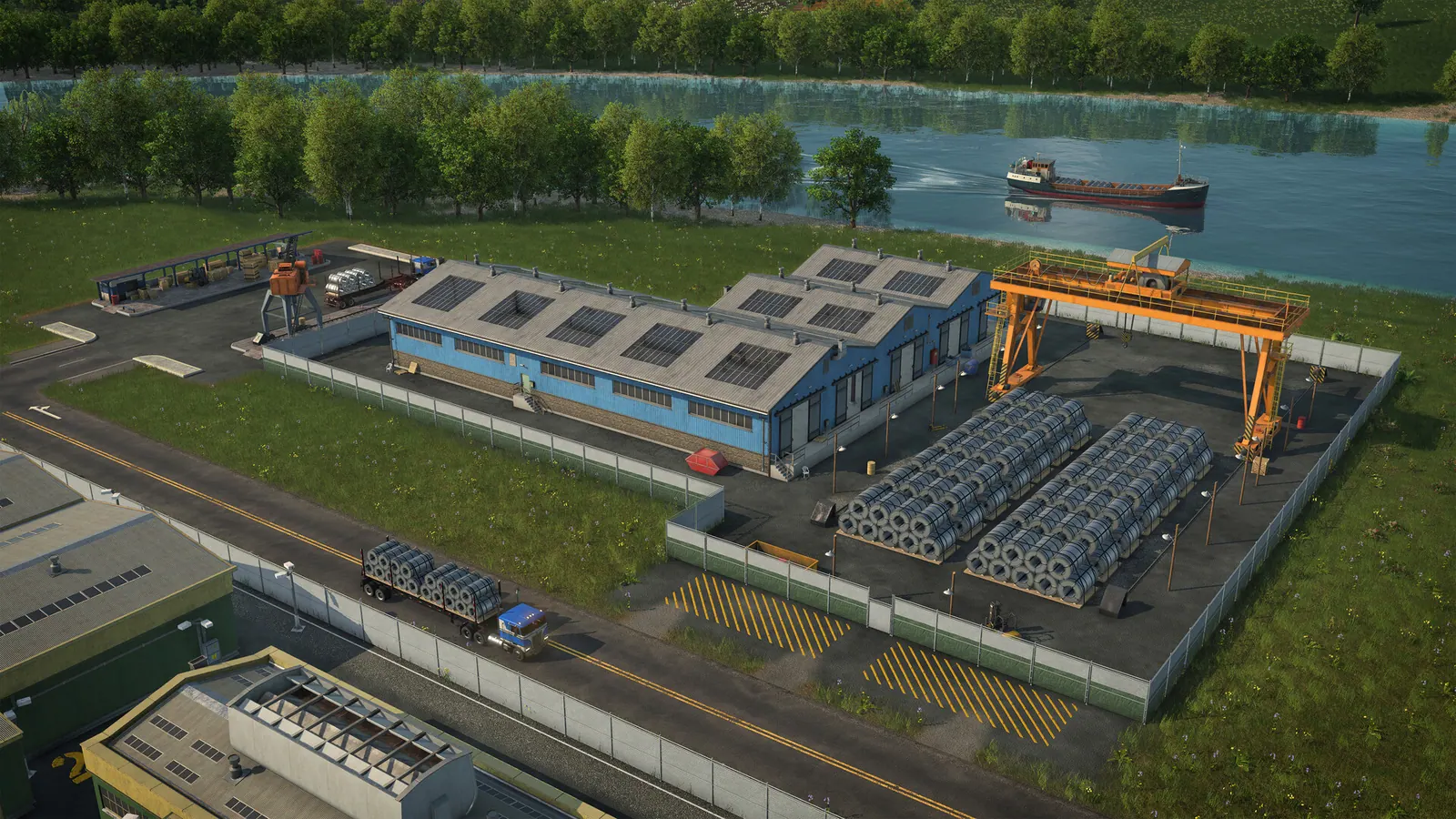
A riverside warehouse and gantry — freight sitting next to town.
Transport Fever 3 tycoon mode still pays you for deliveries, but profit is no longer enough. Town reputation, noise, pollution, traffic, vehicle maintenance, loans and contracts, and a modular company headquarters all shape whether a settlement grows from hamlet toward metropolis. Each of those systems can be eased or disabled with sliders, which is why sandbox and tycoon share the same tools with different defaults.
The 10 September 2026 tycoon gameplay overview is the official film for these sliders. Expand the evidence rows for the individual sliders. Urban Games has not published population bands for hamlet through metropolis.
Tycoon overview
Urban Games posted the tycoon overview on 10 September 2026. It covers needs, noise, pollution and reputation sliders. Click the facade for youtube-nocookie. The infrastructure First Look is the second official film on this route.
Tycoon gameplay overview
10 September 2026 film for reputation, noise, pollution and related sliders.
Infrastructure First Look
Official look at roads, trams and the tools that keep a town from choking.
Sliders you can actually turn down
Official modes copy says difficulty, noise, pollution and reputation are adjustable and can be turned down or off. That is the contract: tycoon is demanding by default, not a locked simulation you cannot ease. Sandbox can disable the economy entirely. Campaign teaches the same tools in eight historic missions.
Use the rows below as a field note, not as formulas. There are no published percentages for how much a noise barrier restores reputation, or how many loans you may hold. The press notes mention pollution plants and greenification; the game page mentions maintenance consequences if you ignore wear.
Headquarters perks, landmarks and company level sit on the other side of the ledger: they are the rewards for staying profitable without choking the town. Deluxe landmarks (Eiffel Tower, Taj Mahal) and the pre-order Great Pyramid are models for that showpiece slot, not a separate tycoon mode.
Town reputation
Reputation limits growth if deliveries, wait times or nuisances disappoint residents. It can be disabled. Keep it on if you want towns to stall when you treat them as cargo sinks; turn it down if you are practising a network without liveability pressure.
Noise
Noise hurts liveability. Official tools include noise barriers and underground railways. Cargo trams and overland trams can still be loud in a street. The slider can be disabled. Pair this with the infrastructure First Look rather than with a guessed decibel table.
Pollution
Pollution also hurts liveability. Press notes mention pollution plants and greenification. The slider can be disabled. Place heavy industry and oil tanks away from housing if you keep the slider on; sandbox players who came to build dioramas can switch it off.
Traffic
Congestion and station bottlenecks are the traffic job. Tools include per-lane control and an overtaking simulation. Data layers highlight hotspots. This is the slider that makes cargo trams and highway ramps worth reading about on the vehicles page.
Maintenance
Vehicles wear, and ignoring that wear has consequences. Maintenance is part of tycoon costs. There is no published breakdown of repair price per class. Budget for it on long helicopter and high-speed lines the same way you budget fuel in any other tycoon.
Loans and contracts
Loans and contracts are risk/reward money and timed objectives. They sit on tycoon difficulty rather than as a separate mode. Fail a contract and you still have the network; no bankruptcy formula is published.
Company headquarters
The headquarters is modular. Landmarks and perks unlock as the company levels. This is the progression layer on top of route profit: you earn the right to place world-famous landmarks, including Deluxe and pre-order extras, instead of dropping them on day one.
Infrastructure that protects the town
Freeform roads, per-lane control, cargo trams, underground trams, tram-trains, highway ramps and overland trams are the published infrastructure list. They exist so you can move class-matched cargo without paving a six-lane truck road through the housing that has to like you.
Underground railways double as a noise tool. Tram-trains let a street line join mainline rail so you are not transferring every crate by hand. Helicopters skip the street entirely when the job is boosting an industry rather than serving a downtown stop. Highway ramps and per-lane control are the road-side pair for the same problem.
Every citizen has a home, a job and places to go, with weather and a day-night cycle. That living-world claim is why wait times show up in the reputation blurb: people are not abstract demand tokens. If you want the decorative version of the same map, sandbox can disable the economy and leave the stills.
A first-week tycoon loop
Connect a starter demand (fish, vegetables or planks) with the matching class. Keep the line short enough that wait times do not tank reputation. Add a noise barrier or a bit of underground rail before you drop a bulk silo next to housing. Fish from an offshore ground still wants a matching ship or truck, not a passenger tram.
When the town wants a complex end product such as canned food, add the extra industries and the goods-class sheds. Take a loan only if the contract timer matches a route you can actually finish. Spend company level on a landmark after the network is stable, not before. Deluxe Eiffel Tower and Taj Mahal are extra models for that slot, not a shortcut past reputation.
If the loop feels like paperwork, lower the sliders or move to sandbox. Campaign's first missions are the tutorial for these tools. Multiplayer is not in focus: Urban Games says the sequel is single-player until that experience is done.
Frequently asked questions
Can I play tycoon without pollution and noise?
Yes. The official FAQ says noise, pollution and reputation sliders can be turned down or off. Tycoon defaults to the demanding mix; sandbox can disable the economy altogether. You are not locked into liveability because you picked the tycoon menu item.
What are town levels from hamlet to metropolis?
First-party overview copy uses hamlet-to-metropolis as the growth arc tied to reputation and needs. Urban Games has not published population bands or a numeric table for those labels. Grow demand by keeping deliveries and liveability acceptable, then watch which complex products appear.