Transport Fever 3 cargo is 37 types in four handling classes. Stock waits at origin until you collect it, so you choose the buyer and the vehicle. Specialised tankers, open wagons, flats and closed vans load their own class faster. Starter towns want fish, vegetables or planks; grown towns add up to six complex end products.
Each class has its own storage and a matching vehicle family.
Liquid
Examples: oil, fuel
Storage: tanks or barrels
Vehicles: tankers
Offshore oil platforms feed this class.
Bulk
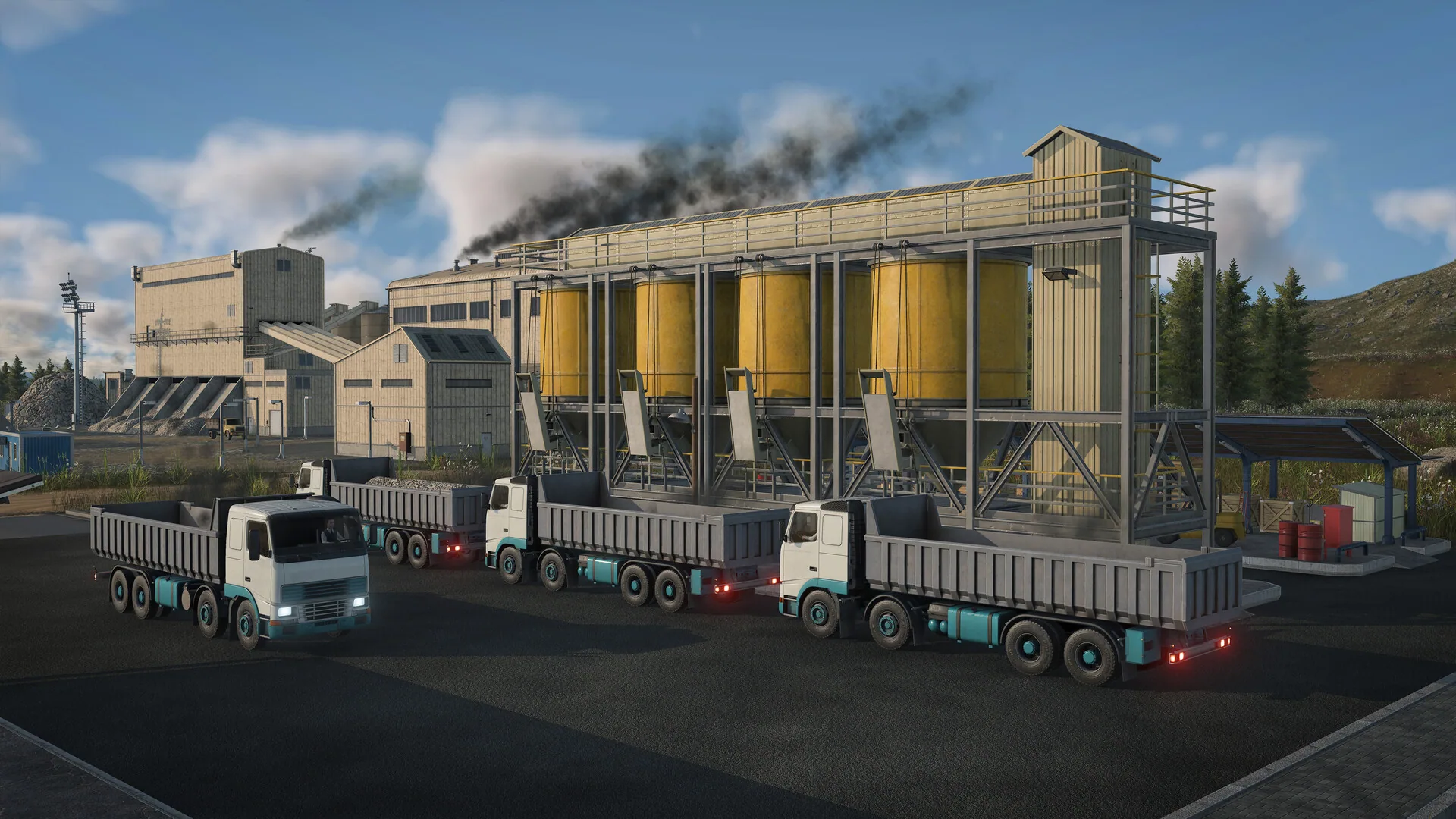
Dump trucks queued under yellow bulk silos.
Examples: sand, grain
Storage: silos or heaps
Vehicles: open wagons and trucks
Open storage wants matching open vehicles.
Flatbed
Examples: logs, steel
Storage: open storage, crane loaded
Vehicles: flat vehicles
Cranes matter more than enclosed sheds.
Goods
Examples: canned food, glass
Storage: freight sheds
Vehicles: closed vehicles
Canned food is the published complex-chain example.
Cargo First Look
The official cargo First Look is the motion picture for loading classes and origin storage. Click to load youtube-nocookie. It supports the four-class table; it does not name all 37 types.
Watch it for tanks, silos, crane yards and sheds in motion after you have filtered the class cards. The film will not add extra cargo names beyond oil, fuel, sand, grain, logs, steel, canned food and glass.
Origin storage changes the route
In earlier series entries, production often implied a destination. Transport Fever 3 keeps cargo at the industry that made it until a vehicle you sent actually picks it up. That is the player-control change Dev Blog Episode 2 describes: you are not filling an invisible order queue so much as deciding which town or factory deserves the stock.
Because stock waits, a tanker parked at an oil platform and a closed van at a cannery are different jobs even if both industries sit on the same map. Mixing classes on one line wastes the faster loading that specialised vehicles get for their own class. Cargo trams help inside the city once goods need street rail rather than a highway queue.
First-party text talks about tanks, silos, heaps, open crane yards and freight sheds at the producing site. If Urban Games later publishes a buildable warehouse building with capacities, that belongs in a revision. Until then, plan storage as origin furniture plus the vehicles that match the class.
An oil platform with no tanker at the dock just keeps filling tanks. A grain silo with no open wagon does the same with heaps. Pair the origin furniture with the wagon that can take it, rather than drawing a hidden destination on the map. Ships cover the water cases when that origin is offshore.
Town demand from fish to canned food
At map start, towns ask for simple cargo such as fish, vegetables or planks. Only the industries those demands require exist at the beginning, so you are not staring at a fully built 35-row production web. Fishing grounds are the offshore example that feeds the fish starter demand.
As a town grows it also wants up to six complex end products. Canned food is the published chain example for that step. That is why goods-class sheds and closed vehicles show up later even if your first week is all bulk sand and flatbed logs. Reputation and wait times on the tycoon page decide whether the town is even allowed to grow into that demand.
Urban Games has not published population bands or a formula that turns reputation into a cargo slot count. The hard numbers in that list are 37 types, four classes, starter examples, and up to six complex end products.
Match the class to a carrier
Liquid wants tankers. Bulk wants open wagons and trucks. Flatbed wants flat vehicles and cranes. Goods want closed vehicles and freight sheds. Helicopters can act as industry boosters rather than as the main hauler. Ships take liquid and bulk over water when an oil platform or a fishing ground is offshore.
Cargo trams sit in the urban freight gap: configurable wagons on street rail, useful when a brewery's integrated loading dock (shown in Dev Blog 2) sits inside a town that you do not want to fill with trucks. Tram-trains can then hand the same cargo onto mainline rail. That handoff is a class-and-infrastructure choice, not a hidden multiplier.
Deluxe does not add extra cargo types in Urban Games. It adds vehicles and landmarks. The 37 types and four classes are base-game rules. If a later patch names the remaining cargo labels, they should slot into these four filters. Matching class to vehicle is the whole loading bonus: tankers for liquid, open wagons for bulk, flats for logs and steel, closed vans for canned food and glass. Helicopters boost plants rather than replacing those haulers.
Frequently asked questions
Where is the list of all 37 cargo names?
Urban Games has not published it. Dev Blog Episode 2 gives the count, the four classes and the examples used in the class cards: oil, fuel, sand, grain, logs, steel, canned food and glass. The remaining names stay unnamed until Urban Games prints them.
Do I still need warehouses?
The official FAQ describes tanks, barrels, silos, heaps, crane-loaded open storage and freight sheds at origin. It does not publish a separate warehouse building with capacities. Plan around origin storage and matching vehicles. If a warehouse tool ships in the launch build with documented numbers, it can be added then.