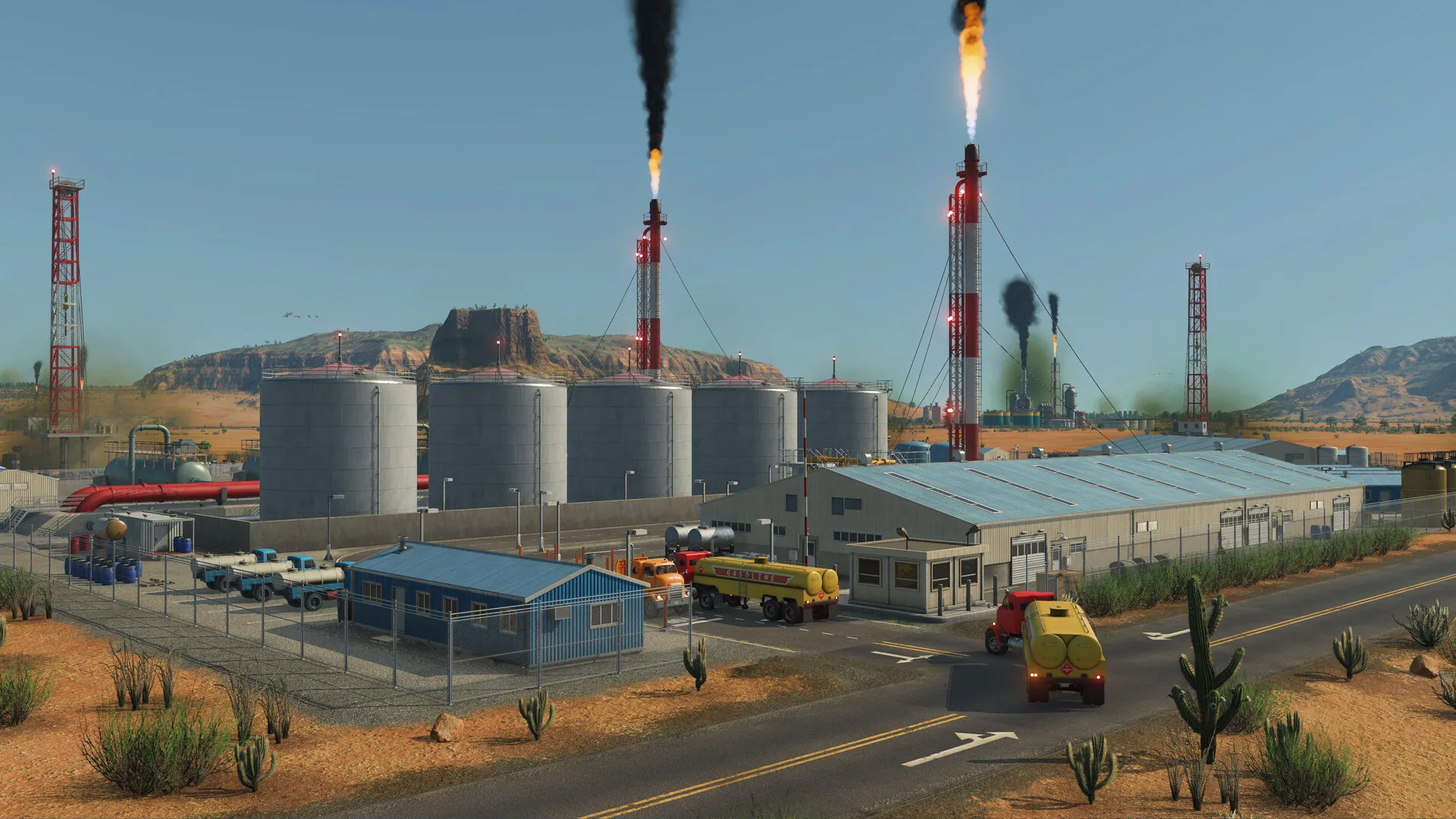
Desert oil terminal with tanks, flares and tanker trucks.
Transport Fever 3 industries include onshore plants and offshore sites. The game page lists over 35 unique industries including fishing grounds and oil platforms; editions copy says over 30 onshore and offshore industries. Both published counts stay visible here. Production can be boosted by workers, optional inputs and industry boosters such as helicopters.
You do not start with the full web. Towns begin with simple demand (fish, vegetables, planks), so only the industries those demands require exist at map start. As towns grow they want up to six complex end products. Urban Games has not published a 35-row roster, so the atlas names the official examples and the offshore jobs rather than a full factory encyclopedia.
Starter towns only ask for fish, vegetables or planks, so only those plants exist at map start. Complex end products such as canned food appear after the town grows. Helicopters boost output at a pad; ships and tankers move offshore liquid and fish. Cargo still waits at origin until you collect it. Official Steam, FAQ and news posts are the numbers and names used throughout; unpublished rows stay unpublished.
Fishing grounds and oil platforms
Fishing grounds are the offshore starter. Fish is one of the simple cargos a new town can demand, so a coastal or lake map can put your first route on water instead of on a grain siding. The still on the campaign page shows cages and barges; treat that as the visual for this job, not as a named mission.
Oil platforms sit in the liquid class. They output oil that wants tanks or barrels on land and tankers on the water. A helicopter pad is the official booster language for industries, which matters more on an offshore deck than on a roadside sawmill. The desert terminal still on the desert still is the onshore face of the same liquid chain.
Ships, helicopters and (once cargo reaches town) trucks or cargo trams are the connecting classes. There is no published table of platform barrels-per-minute. Plan the route as: platform or ground → matching storage → matching vehicle → town or refinery, then watch reputation if the line is loud or late.
Onshore plants and the brewery dock
Dev Blog Episode 2 shows a brewery with an integrated loading dock. That is the onshore example Urban Games chose to film: production and street loading in one footprint, which is why cargo trams and closed goods vehicles show up in town instead of forcing every crate onto a highway. It is not a complete list of factories.
Optional inputs and workers are the published boosters besides helicopters. The official FAQ does not give percentages. If a plant accepts an extra input, that is a second incoming class to schedule, not a published multiplier. Keep bulk, liquid, flatbed and goods on matching vehicles so the faster loading bonus actually applies.
More than thirty onshore and offshore industries is the editions wording; over 35 unique industries is the game-page wording. Neither line is collapsed into a fake exact count. When a named roster ships, each row should keep its class, its climate, and whether it is offshore.
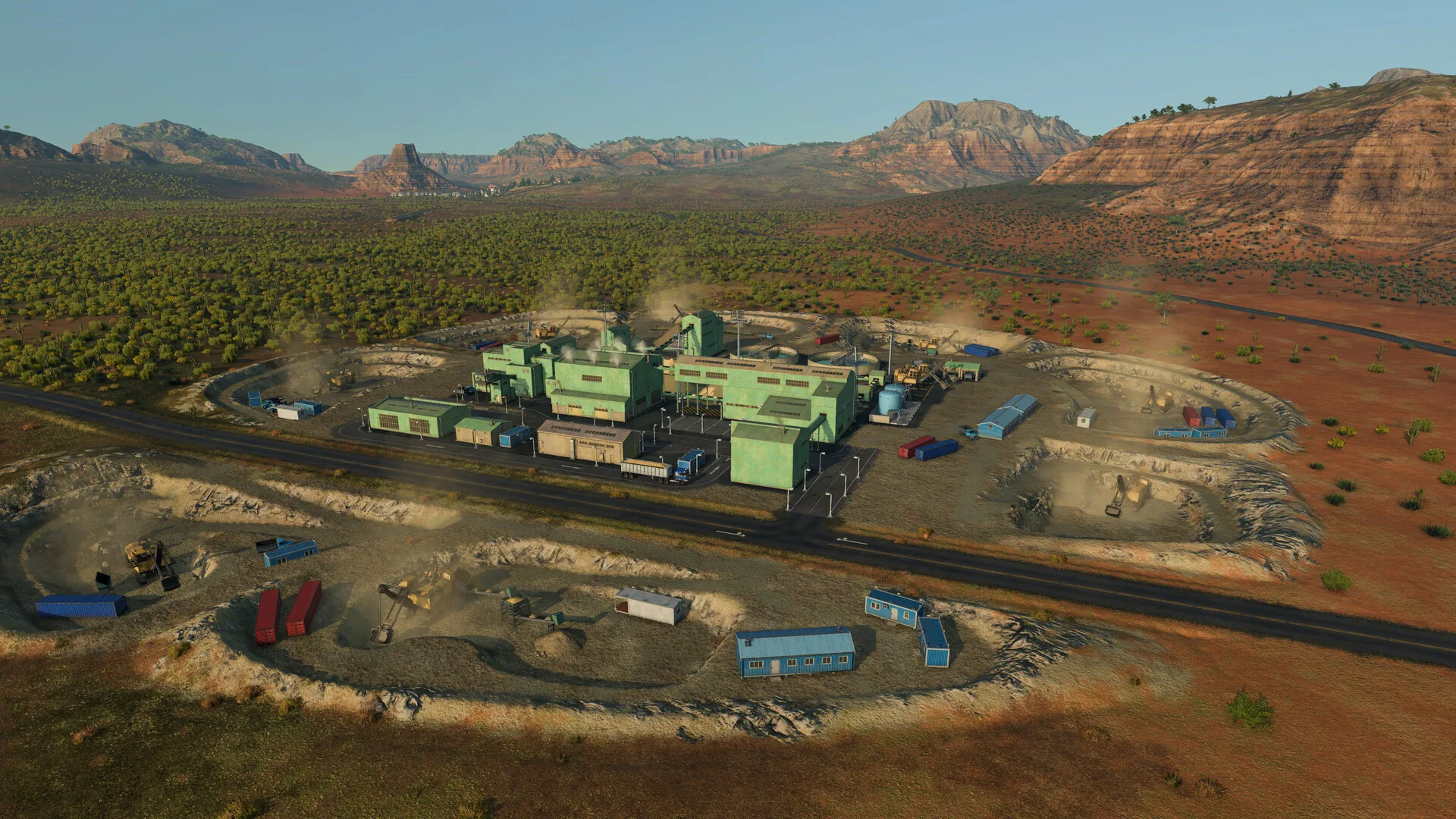
A green processing plant in a red-rock quarry — onshore bulk country.
Demand unlocks the chain
At start, only required industries exist. That is the opposite of dumping 35 plants on the map and daring you to connect them. Fish, vegetables and planks are the published simple demands. Canned food is the published complex example once a town grows and wants up to six end products.
Liveability gates that growth. If noise, pollution or wait times wreck reputation, the town never asks for the complex goods that would justify a cannery. Tune those sliders on the tycoon page, or turn them down in sandbox, before you lay a second heavy industry next to housing.
Climate also filters what you see. Temperate forests, desert plains, tropical islands and the new subarctic region (including swamps) change which stills look right; they do not yet come with a published industry-per-biome table. Place offshore jobs on water, liquid tanks away from housing, and goods sheds on street rail when the brewery dock pattern shows up in town. Optional inputs are a second incoming class, not a hidden percentage. A brewery dock in town wants goods wagons or cargo trams; an oil platform wants tankers and a helicopter pad if you use the booster. Towns only spawn the plants their current demand needs, so a new map is a short chain of fish, vegetables or planks until reputation lets canned food appear.
Frequently asked questions
How many industries are in Transport Fever 3?
The official game page says over 35 unique industries including offshore fishing grounds and oil platforms. Editions copy says over 30 onshore and offshore industries. Both lines come from Urban Games. There is no published 35-row name list, so the atlas keeps the range and the named examples rather than filling the gap from another wiki.
Can helicopters replace ships to an oil platform?
Helicopters are described as passenger and freight carriers and as industry boosters. Ships remain the water class from paddle-steamers to supertankers. Use a helicopter pad to boost a platform if you want the booster effect; use tankers when the job is moving liquid cargo in volume. The official FAQ does not publish a substitution ratio.